
Author: Israel Oba

  • Consent Orders, Form D81 and Final Order

    If you and your ex-partner have already reached an agreement about money or property after divorce, you may be wondering how to make that agreement legally binding. In England and Wales, that usually means applying for a consent order. GOV.UK explains that a consent order is used when you have agreed how to divide money and property and want the court to approve that agreement.

    A lot of people also come across Form D81, and many are unsure how it fits into the process or whether they need it at all. There is also an important timing issue: GOV.UK says the court cannot approve a consent order before you have your conditional order (or decree nisi), and warns that if you want a legally binding arrangement for dividing money and property, you should apply for it before applying for the final order (or decree absolute), because there may be financial consequences, particularly for pensions.
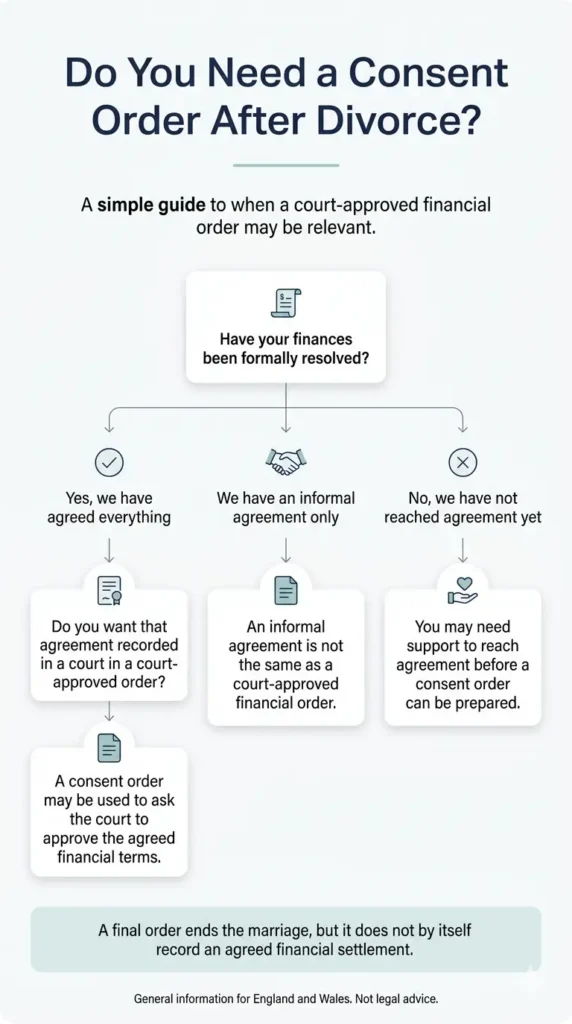
    Infographic decision tree titled "Do You Need a Consent Order After Divorce?" illustrating the process for financial settlements in England and Wales.
    A simple guide to understanding when a court-approved financial order (Consent Order) may be relevant after your divorce is finalised in England and Wales.

    A consent order is a proposed financial order that reflects an agreement already reached between you and your ex-partner. Instead of asking the court to decide a financial dispute after a hearing, you are asking the court to approve the terms you have both agreed. The court says that when you ask for approval, you and your ex-partner must draft a consent order, sign it, complete a statement of information form, and send the required documents and fee to the court.

    This matters because reaching an agreement between yourselves does not automatically make it enforceable. A consent order is the step that asks the court to turn an agreed financial arrangement into a formal court order. Divorce finance guidance separates informal agreement from a court-approved financial order, which is why many people choose to formalise matters even when relations are relatively cooperative.

    What is Form D81?

    Form D81 is the statement of information used to support an application for a consent order in relation to a financial remedy. HMCTS says the purpose of the form is to help the court decide whether the financial and property arrangements you have made are fair.

    In practice, Form D81 gives the judge a snapshot of both parties’ financial position and the terms of the agreement. That is why it is so important to complete it carefully and honestly. The form itself refers to matters such as dates of birth, relevant children, income, assets, liabilities, and whether a decree absolute or final order has been made.

    Do I need a consent order after divorce?

    Not everybody applies for a consent order, but it is often an important step where money, property, pensions, or ongoing financial claims need to be settled clearly. The court’s guidance on money and property after divorce says that if you want a legally binding arrangement for dividing finances, you need to apply to the court. That is the practical reason people often ask for a consent order even where they are already in agreement.

    This is especially relevant where there are assets to divide, pension issues to deal with, or a wish to bring financial claims to an end as far as possible. The blog should be careful here: a consent order is not “mandatory” in every case, but it is often the route people use when they want legal certainty around an agreed settlement. That is a safer and more accurate way to explain it.

    When should you apply for a consent order?

    The court says it is usually simpler to ask the court to approve a consent order after you have your conditional order (or decree nisi), because the court cannot approve a consent order before that stage. The same guidance also says you should apply before your final order (or decree absolute), because leaving it until after final order can have financial consequences, particularly for pensions.

    That timing point is one of the most important practical issues in this whole area. A lot of people assume that once the divorce is finished, they can sort out finances later with no downside. HMCT’s guidance makes clear that this can be risky, which is why consent-order timing should always be considered alongside the divorce timetable.

    Should you get a consent order before the final order?

    In many cases, yes. The court expressly says that if you want a legally binding arrangement for dividing money and property, you should apply for it before applying for the final order or decree absolute. It also says the consent order itself will only take effect after the final order or decree absolute is made.

    That means two things can be true at once. First, the court normally wants the application for approval to come before final order. Second, the consent order does not take effect until final order is made. For readers, that is the key timing sequence to understand.

    What happens if you divorce without a consent order?

    If you divorce without putting a legally binding financial order in place, you may leave financial matters unresolved. HMCTS guidance does not say that every divorced person must get a consent order, but it does say that if you want a legally binding arrangement for dividing money and property, you need to apply to the court. That is why many people seek advice about a consent order even when they believe they have already agreed everything informally.

    This does not mean every case will require the same solution. However, it does mean a blog on this topic should explain that divorce itself and financial finality are not always the same thing. The divorce ends the marriage; the financial order deals with agreed financial arrangements.

    Can mediation help before a consent order?

    Often, yes. Mediation can help separating couples discuss finances and reach proposals without asking the court to decide the outcome for them. If agreement is reached, the next step may then be to ask the court to approve that agreement through a consent order. That creates a natural bridge between mediation and the formal court approval process. Part 9 of the Family Procedure Rules governs financial remedy applications, while the court explains the separate practical steps for asking the court to approve a consent order.

    At the same time, mediation and a consent order are not the same thing. Mediation may help people reach terms, but the consent order is the stage where the court is asked to approve the agreed financial arrangement. Form D81 supports that approval process by giving the court information about the parties’ financial circumstances.

    How does this differ from Form A and Form E?

    This is a different part of the divorce-finance journey. Form A and Form E are more closely associated with starting and managing a financial remedy application where finances are disputed or require formal disclosure. By contrast, consent orders and Form D81 sit more naturally in the agreed-settlement pathway. The courts separates Form A from the D81 consent-order material, and Part 9 of the Family Procedure Rules applies broadly to financial remedy applications.

    A practical next step

    If you have reached agreement about money or property after divorce, the next question is usually whether that agreement now needs to be turned into a legally binding order. In England and Wales, that is where the consent-order process and Form D81 commonly come in. GOV.UK’s guidance makes clear that timing matters, especially in relation to conditional order and final order.

    For many people, the safest next step is to understand whether agreement has really been reached, whether mediation may still help refine the details, and whether the paperwork for a consent order is ready to go to court. That is often the point at which people ask about Form D81, legal drafting, and when to apply before final order.

    Book a consultation regarding your divorce mediation.

    0330 133 4858 Mon – Friday 9.00am – 5.00pm

    Further Information:

  • Form A and Form E: Applying for a Financial Order in England and Wales

    If you are sorting out finances after divorce or separation, two forms often cause confusion: Form A and Form E. They are linked, but they do different jobs. In England and Wales, Form A is used to start a request for a financial order in divorce or civil partnership proceedings, while Form E is the financial statement used for disclosure in those proceedings. GOV.UK describes Form A as the form to start a request for a financial order, and the official Form E notes say it should be completed where an application for a financial order has been made in England and Wales.

    For many people, the hardest part is not the paperwork itself. It is understanding where these forms fit into the wider financial remedy process, when mediation may come first, and what happens if agreement is not possible. This guide explains the role of Form A, Form E, and the court-led process for resolving money and property issues in England and Wales.

    What is Form A?

    Form A is the form used to begin an application for a financial order. GOV.UK says it is used to start a request for a financial order in proceedings for divorce or ending a civil partnership. The current Form A also states that, before making an application for a financial order, you must first attend a Mediation Information and Assessment Meeting (MIAM) unless an exemption applies.

    In practical terms, Form A is often the point where a financial dispute becomes a formal court process. People usually consider this route when:

    • they cannot reach agreement about money or property
    • disclosure is incomplete or disputed
    • there are concerns about delay, non-cooperation, or hidden assets
    • mediation is unsuitable or has not resolved the issues

    A financial order can cover matters such as property, lump sums, maintenance, and pensions, depending on the case. Part 9 of the Family Procedure Rules governs applications for a financial remedy in England and Wales.

    What is Form E?

    Form E is the financial statement used in financial order cases. The official form says it should only be completed in applications for a financial order in divorce, dissolution, annulment, or separation proceedings in England and Wales, or in certain overseas-relief cases. The accompanying notes also explain that you should only complete Form E if you or your spouse or civil partner has made an application for a financial order.

    Form E is about financial disclosure. It is designed to give the court, and the other person, a detailed picture of your financial circumstances. That commonly includes:

    • income
    • bank accounts and savings
    • property
    • debts and liabilities
    • pensions
    • investments
    • business interests
    • future financial needs

    The official Form E notes state that each person must give “full, frank and clear disclosure” of all relevant financial circumstances. They also warn that if full and accurate disclosure is not given, a court order may later be set aside.

    What is the difference between Form A and Form E?

    The simplest way to understand the difference is this:

    • Form A starts the court application
    • Form E provides the financial disclosure within that process

    So, if you are asking the court to deal with finances, Form A is the form that opens the case. Form E is then used to set out the financial information the court needs to understand the dispute. That structure is reflected in GOV.UK’s Form A guidance and in the official Form E notes.

    Do you need a MIAM before Form A?

    Usually, yes. The current Form A says that before making an application for a financial order you must first attend a MIAM, where an authorised family mediator will consider whether mediation or another form of non-court dispute resolution may be more appropriate, unless an exemption applies.

    That does not mean mediation is right for every case. Sometimes mediation can help people discuss finances constructively. In other cases, especially where there is serious non-disclosure, coercive control, safeguarding concerns, urgency, or another valid exemption, a court route may be more appropriate. The key point is that the MIAM requirement and the possibility of exemptions sit at the start of the process.

    When are Form A and Form E usually used?

    Form A and Form E are usually relevant when finances cannot be resolved informally or through mediation alone. That may include cases involving:

    • disagreement about the family home
    • disputes about savings or debts
    • pension issues
    • maintenance claims
    • concerns about business interests
    • suspected hidden assets
    • failure to provide proper disclosure

    Part 9 of the Family Procedure Rules applies to applications for a financial remedy, and Practice Direction 9A supplements that procedure.

    What happens after Form A is filed?

    Once a financial remedy application is underway, the court process usually moves into structured disclosure and appointments under Part 9. While the exact route can vary by case type, the overall purpose is to move the matter through disclosure, negotiation, and, if possible, settlement. Part 9 also defines the Financial Dispute Resolution appointment (FDR), which is a settlement-focused stage within the process.

    This is one reason why Form E matters so much. Without proper financial disclosure, meaningful negotiation is difficult. Where disclosure is incomplete or inconsistent, the process can become slower, more expensive, and more stressful.

    What if your ex will not provide proper disclosure?

    This is one of the most common concerns in financial cases. A person may engage in discussions at first but still avoid full disclosure. For example, they may:

    • delay producing bank statements
    • minimise income
    • omit investments
    • fail to explain transfers
    • leave out cryptocurrency or overseas assets

    The official Form E notes make clear that full and accurate disclosure is required, and that a failure to provide it can have serious consequences for any resulting order.

    Mediation can sometimes help identify gaps in information, but a mediator does not act as a judge or investigator. If one person will not disclose properly, a formal court process may be needed so the case can proceed within the financial remedy framework.

    Can mediation still help before or alongside this process?

    Sometimes, yes. The Form A guidance itself highlights the role of the MIAM and non-court dispute resolution before an application is made. For some couples, mediation may help narrow issues, improve communication, and support discussions about finances.

    However, mediation has limits. It usually works best where both people are willing to engage honestly and provide a reliable picture of their finances. If there are serious concerns about hidden assets, intimidation, or refusal to disclose, mediation may not be enough on its own.

    What does the court mean by “financial remedy”?

    Under Part 9 of the Family Procedure Rules, the process is described as an application for a financial remedy. That term covers a range of financial orders the court can make in family proceedings. The official rules govern how those applications proceed, including disclosure and court appointments.

    For readers, the important point is that Form A and Form E are not random paperwork. They sit inside a formal system designed to deal with finances when agreement has not yet been reached.

    Is this the same as a consent order?

    Not exactly. A consent order usually relates to an agreement that has already been reached and is then sent to the court for approval. By contrast, Form A and Form E sit more naturally in the court-application and disclosure side of the process, where finances are disputed, unresolved, or still being worked through. GOV.UK separates Form A guidance from the consent-order materials, which is one reason these topics are better treated as different content clusters.

    A practical next step

    If you are trying to understand Form A and Form E in England and Wales, the first question is usually whether finances can still be resolved through discussion or mediation, or whether a formal financial remedy application is becoming necessary. Where agreement is not possible, or where disclosure is a problem, legal advice may be important.

    A MIAM may still be the first step unless an exemption applies. From there, the question is whether mediation is realistic, or whether the matter is likely to move into the court-led process involving Form A, Form E, and wider financial disclosure.

    This content is for general information only and is not legal advice.

    Further Information:

  • Hidden Assets in Divorce and Separation in England and Wales

    Divorce and separation can already feel uncertain. However, when one person suspects the other is hiding money, property, or investments, the situation often becomes even more stressful. In England and Wales, financial arrangements after divorce depend heavily on proper financial disclosure. The official Form E states that each person has a duty to give the court “full, frank and clear disclosure” of their financial and other relevant circumstances, and warns that failure to do so may result in an order being set aside.

    For some people, the concern is a bank account that was never mentioned. For others, it may be cryptocurrency, money moved overseas, or funds held in an offshore account. In practice, the issue is rarely just about the asset itself. Instead, the real problem is whether both people are being open enough for mediation or financial negotiations to work fairly.

    What are hidden assets?

    Hidden assets are assets, income, or resources that one person does not properly disclose during divorce, separation, or financial remedy discussions. They may include:

    • bank accounts not mentioned in disclosure
    • savings transferred elsewhere
    • undeclared bonuses, commissions, or business income
    • investments and shareholdings
    • property held through a company or another person
    • money held abroad
    • offshore accounts
    • cryptocurrency and other digital assets

    Not every unfamiliar transaction proves wrongdoing. Even so, if a significant asset or source of income is left out of disclosure, that can affect the fairness of any proposed settlement.

    Why disclosure matters in England and Wales

    A fair financial outcome depends on both people understanding the true financial picture. Under the Family Procedure Rules, financial remedy cases in England and Wales are governed by Part 9, and the court process includes formal financial disclosure through Form E and related evidence.

    That matters in mediation too. Mediation can help couples discuss finances in a more structured and constructive way. However, mediation usually works best where both people are willing to engage honestly. If one person appears to be concealing assets, withholding documents, or giving inconsistent information, the process may become limited or unsuitable.

    Common signs a partner may be hiding assets

    Suspicion does not always mean concealment. Nevertheless, some signs can justify closer scrutiny. For example:

    • incomplete or delayed disclosure
    • vague explanations about finances
    • sudden transfers between accounts
    • unusual cash withdrawals
    • unexplained reductions in salary or business income
    • missing bank statements or tax documents
    • references to trading platforms, wallets, or overseas accounts
    • assets appearing in the name of a friend, family member, or company

    These signs do not prove that assets are being hidden. Even so, they may indicate that further clarification, legal advice, or formal disclosure is needed.

    Can cryptocurrency be hidden in divorce?

    Yes, cryptocurrency can be relevant in divorce and separation. If digital assets exist, they should form part of the wider financial disclosure picture, even though they may be harder to identify and value than a traditional bank account.

    Cryptoassets may include:

    • Bitcoin
    • Ethereum
    • stablecoins
    • token-based investments
    • assets stored on exchanges
    • assets stored in software or hardware wallets

    In some cases, the difficulty is not whether the crypto exists, but where it is held, whether it has been moved, and how it should be valued. Because crypto can be transferred quickly and may be spread across multiple platforms or wallets, it can create additional complexity. Even so, it is still part of a person’s financial circumstances and should not be omitted simply because it is digital.

    Offshore accounts and overseas assets

    Offshore accounts are another area of concern. An offshore account is not automatically improper. However, if it exists and is relevant to a person’s financial circumstances, it should be disclosed.

    The same can apply to:

    • overseas bank accounts
    • foreign property
    • international investments
    • offshore companies
    • trusts or nominee arrangements

    Where money has been moved abroad, or assets are held through more complicated structures, it may be harder to understand the full position. Even so, the key issue remains the same: honest disclosure.

    Can mediation help if you suspect hidden assets?

    Sometimes, yes. Mediation can still be useful where both people are broadly willing to engage and the concern is about clarification rather than deliberate concealment. A mediator can help structure discussion, identify gaps in information, and encourage both sides to work from the same financial picture.

    However, mediation has limits. A mediator is neutral and does not act as a judge, investigator, or forensic accountant. While a mediator can facilitate the exchange of information, they do not have the power to investigate, cross-examine, or verify documents in the way a court can. Because of that, mediation may not be enough where serious non-disclosure is suspected.

    If one person refuses to provide proper information, gives inconsistent answers, or appears to be concealing assets, mediation may stall or become unsuitable. In more complex cases, including those involving business interests, cryptocurrency, offshore accounts, or disputed disclosure, some people also seek support from a solicitor or forensic accountant alongside the mediation process.

    What happens if assets are not disclosed?

    The consequences can be serious. Form E warns that failure to give full and accurate disclosure may result in a court order being set aside. It also notes that deliberate failure may amount to fraud.

    In practical terms, non-disclosure can lead to:

    • delay in settlement
    • more requests for documents and information
    • greater legal cost
    • loss of trust in negotiations
    • court involvement where agreement cannot be reached
    • future challenges to an order if important assets were concealed

    So, even where a case begins in mediation, unresolved concerns about hidden assets can push the matter toward a more formal process.

    What if your ex refuses to disclose properly?

    This is one of the most common concerns in financial disputes. A person may attend mediation or financial discussions, but still avoid meaningful disclosure. For example, they may:

    • refuse to provide statements
    • minimise the value of assets
    • deny owning cryptocurrency
    • fail to explain overseas transfers
    • provide incomplete information about business interests

    Where that happens, mediation may no longer be productive. A mediator can identify that disclosure is incomplete, but cannot force a person to be truthful in the same way a court process can. In England and Wales, the court’s financial remedy framework provides for structured disclosure and further steps where more information is needed.

    Does a MIAM still matter in these cases?

    Sometimes it does. Under Part 3 of the Family Procedure Rules and Practice Direction 3A, a MIAM is usually required before certain family court applications unless an exemption applies, and the practice direction says prospective respondents are expected to attend as well.

    Even so, attending a MIAM does not mean mediation must continue. If the issue is serious concealment, power imbalance, or unsuitability, mediation may not be the right forum. In that situation, a MIAM can still help clarify the next step.

    Can funding or vouchers help?

    Possibly, but only in some cases. GOV.UK says the Family Mediation Voucher Scheme can provide a one-off contribution of up to £500 towards eligible mediation cases. It does not cover the cost of the MIAM itself, and not all cases qualify. GOV.UK also states that if one or both people are eligible for legal aid, funding may cover the MIAM and mediation sessions through providers who offer legal aid work.

    That said, a voucher does not solve a disclosure problem by itself. The more important question is whether there is enough openness for mediation to be workable.

    What should you do if you think your partner is hiding assets?

    The safest approach is usually to stay organised and factual. It may help to:

    • keep copies of financial documents you already lawfully have
    • note accounts, transfers, or transactions you do not understand
    • raise concerns clearly and calmly
    • ask whether mediation is suitable
    • seek independent legal advice where concealment appears serious

    If court proceedings become necessary, the financial remedy process can provide a more formal framework for disclosure and follow-up questions. GOV.UK also explains that if couples cannot agree on money or property, they may ask the court to make a financial order.

    A practical next step

    If you are worried that your ex-partner is hiding assets, cryptocurrency, or offshore money, the next step is often to understand whether mediation is still realistic or whether legal advice is needed straight away. In some cases, mediation can still help clarify the issues. In others, the lack of openness may mean a more formal route is appropriate.

    This content is for general information only and is not legal advice.

    Further infromation:

  • What If Your Ex Will Not Mediate or Cooperate?

    One of the most common concerns after separation is this: what happens if my ex will not mediate, will not respond, or simply refuses to cooperate? In England and Wales, the answer depends on whether you are dealing with mediation, child or financial arrangements, or the divorce process itself.

    If your ex refuses to mediate

    Mediation is not something you can force on another person. For certain family court applications, attending a MIAM is usually required unless an exemption applies, but that does not mean the other person has to continue with mediation or agree to mediate fully. The rules say the prospective respondent is expected to attend a MIAM, but mediation itself may still not go ahead if they refuse, do not engage, or the mediator decides it is not suitable.

    If your ex will not mediate, that does not automatically end your options. A mediator can usually confirm that mediation was considered or attempted, and that may allow you to move to the next step where a court application is otherwise appropriate. Whether that applies will depend on your circumstances, the type of application, and whether any exemption is available.

    If your ex attends but does not cooperate

    Sometimes the issue is not outright refusal, but limited engagement. A person may attend a MIAM and then:

    • refuse joint sessions
    • delay responses
    • decline to provide information
    • reject every proposal without discussion

    In those situations, mediation may still not be workable. Mediation usually depends on both people being willing and able to participate meaningfully. If one person will not engage constructively, the mediator may conclude that mediation is not suitable or is no longer productive. That does not mean you have failed. It simply means a different route may be needed.

    If your ex ignores the divorce application

    This is different from refusing mediation. In England and Wales, under no-fault divorce, a person cannot usually stop the divorce just because they do not want it. GOV.UK states that you cannot disagree with the divorce simply because you do not want one.

    If the respondent does not reply, the divorce can still continue through the court process. GOV.UK explains what happens after the application is issued and what happens if the other person does not respond.

    So, while a difficult spouse or partner can cause delay or stress, they do not usually have a veto over the divorce itself.

    If your ex refuses to cooperate about children or finances

    This is often the hardest part emotionally. A person may not be able to stop the legal divorce, but they can still make it difficult to resolve practical issues like:

    • child arrangements
    • financial disclosure
    • property decisions
    • pension discussions
    • interim day-to-day agreements

    Where this happens, mediation may still be explored if safe and appropriate. However, if the other person will not engage at all, or if there are concerns about abuse, coercive control, safeguarding, or urgency, court or legal advice may be more appropriate. The Family Procedure Rules require the court to consider whether mediation or another form of non-court dispute resolution was attempted, whether a MIAM took place, and whether an exemption was claimed.

    What you can do if the other person will not engage

    If your ex will not mediate or cooperate, practical next steps may include:

    • booking a MIAM yourself
    • asking a mediator to assess whether mediation is suitable
    • finding out whether an exemption applies
    • getting legal advice on your position
    • making a court application where necessary and appropriate

    If there are safety concerns, urgency, or serious imbalance, tell the mediator or your solicitor as early as possible. Mediation is not suitable in every case, and the right next step depends on the facts.

    Further information:

  • Divorce Mediation Glossary (England & Wales)

    This glossary explains the legal, court and mediation terms commonly used in divorce and financial remedy matters in England and Wales. It covers key forms, orders, hearing stages and mediation documents, including terms such as Form A, Form D81, MIAM, consent order and clean break.

    Use the glossary to quickly check what a term means in plain English. If you want to see how a term fits into the wider process, use the related links within each entry to move to the relevant guide or topic page.

    Jump to a section:

    A – C | D–F | G–L | M–R | S–Z

    A – C

    Acknowledgment of Service (AoS)

    The Respondent’s formal confirmation that they received the divorce application, sometimes including their position on jurisdiction.

    Add-Back

    A discretionary approach where money unfairly spent or dissipated is treated as if it were still available when assessing fairness.

    Applicant

    The person applying for divorce or financial remedy. In a joint divorce, both spouses are applicants.

    Application

    The formal document used to start court proceedings.

    Arbitration (Family)

    A private process where an independent arbitrator makes a decision on a family finance dispute, usually later reflected in a court order.

    AoS

    Short for Acknowledgment of Service.


    Calderbank Offer (Without Prejudice Save as to Costs)

    A settlement offer normally hidden from the trial judge on the merits, but which may later be shown when arguing about costs.

    Capital

    Assets with a present value, such as property, savings, investments, or business interests.

    CETV (Cash Equivalent Transfer Value)

    The standard figure used to value a pension for divorce purposes.

    Chronology

    A dated timeline of important events in the case.

    Clean Break

    A financial order that ends future financial claims between spouses, so neither can make further claims later.

    Collaborative Law

    A solicitor-led process where both parties and their lawyers work to reach agreement without going to court.

    Conditional Order

    The first divorce order confirming that the divorce can proceed. This replaced the old term Decree Nisi.

    Conditional Order vs Final Order

    A Conditional Order confirms the divorce can move forward. A Final Order legally ends the marriage.

    Conduct (Financial)

    Serious financial misconduct that may affect the outcome of a financial remedy case. This is uncommon.

    Consent Order

    A court order recording an agreement between spouses, which becomes binding only once approved and sealed by the court.

    Consent Order vs Informal Agreement

    An informal agreement is not automatically enforceable. A Consent Order is binding once sealed by the court.

    CMS

    Child Maintenance Service, which deals with most child maintenance cases.


    D–F

    Decree Absolute

    The old term for Final Order.

    Decree Nisi

    The old term for Conditional Order.

    Decree of Nullity / Nullity Order

    The court order declaring a marriage void or voidable.

    Deemed Service

    Where the court accepts that documents were received, even if formal proof of service is incomplete.

    Directions

    Court instructions setting out the next procedural steps, such as disclosure, questionnaires, or expert evidence.

    Disclosure Documents

    Documents supporting financial disclosure, such as bank statements, payslips, tax returns, pension statements, and valuations.

    Disclosure “light” vs non-disclosure risk

    Even in agreed cases, incomplete disclosure can create a risk that the order may later be challenged.

    Dispensation of Service

    Permission from the court to continue without serving documents in the usual way, for example where the other party cannot be traced.

    Dispute of Jurisdiction

    A challenge arguing that the courts of England and Wales should not deal with the divorce.

    Divorce vs Financial Order

    Divorce ends the marriage. A financial order deals with money, property, pensions, and future claims.

    Domicile

    A legal concept used to identify a person’s permanent home, which can affect jurisdiction.

    Draft Consent Order

    The proposed wording of the financial order the parties want the court to approve.

    Duty of Full and Frank Disclosure

    The obligation to give complete and honest financial information.


    Equity

    The net value of a property after deducting the mortgage and sometimes sale costs.

    ES1

    A standard court form summarising the financial remedy case for a hearing.

    ES2

    A standard schedule setting out the parties’ assets and liabilities for a hearing.


    FDA (First Appointment / First Directions Appointment)

    The first court hearing in contested financial remedy proceedings, where the judge usually gives directions.

    FDR (Financial Dispute Resolution Hearing)

    A without-prejudice settlement hearing where the judge helps the parties try to reach agreement.

    Final Hearing

    The trial at which the judge decides the case if no agreement has been reached.

    Final Order

    The order that legally ends the marriage. This replaced the old term Decree Absolute.

    Final Order vs Financial Finality

    A Final Order ends the marriage, but it does not automatically end financial claims. Financial finality usually requires a sealed financial order, often with a clean break.

    Financial Remedy

    The court process for resolving financial claims between spouses, including property, income, capital, and pensions.

    Financial Remedy Application

    The application asking the court to decide or approve financial arrangements.

    Form A

    The main form used to start financial remedy proceedings, including applications for a consent order.

    Form A (Consent) vs Form A (Contested)

    The same form starts both routes, but in a consent case you submit it with the agreed order and supporting documents.

    Form A1

    A different form used for limited applications outside the standard Form A route.

    Form D81

    The Statement of Information used in consent order cases so the judge can assess whether the agreement appears fair.

    Form E

    The main financial disclosure form used in contested financial remedy proceedings.

    Form E vs D81

    Form E is detailed disclosure for contested cases. Form D81 is a shorter fairness snapshot used for consent orders.

    Form P

    A pension inquiry form used where pension orders may be relevant.

    Form P1 (Pension Sharing Annex)

    The technical annex required where the order includes pension sharing.

    Forum

    The country whose courts should deal with the dispute.

    FRC

    Financial Remedies Court, the specialist court structure dealing with financial remedy cases.


    G – L

    Habitual Residence

    The place where a person’s life is practically centred and settled.

    Hearing Bundle

    The indexed and paginated set of documents prepared for the judge.

    Help with Fees (HWF)

    A scheme that may reduce or remove court fees for eligible applicants.

    HMCTS

    HM Courts & Tribunals Service, which administers the courts.


    Income

    Earnings and other incoming money, such as salary, self-employment income, rent, dividends, or benefits.

    Irretrievable Breakdown

    The only legal basis for divorce in England and Wales.

    Issue / Issued by the Court

    The point at which the court accepts the application and starts proceedings.


    Joint Application

    A divorce application made together by both spouses.

    Judicial Separation

    A court process recognising separation without legally ending the marriage.

    Jurisdiction

    The court’s legal authority to hear and decide a case.


    Legal Costs / Costs Order

    Legal costs are the expenses of the case. A costs order requires one party to pay some or all of the other party’s costs.

    Liabilities

    Debts and financial obligations, such as mortgages, loans, tax debts, or credit cards.


    M–R

    Marriage Certificate

    The official document proving the marriage, usually needed to issue the divorce application.

    Matrimonial Assets

    Assets built up during the marriage, often treated as part of the shared marital pot.

    Mediation

    A process where an independent mediator helps the parties negotiate, but does not impose a decision.

    Memorandum of Understanding (MoU)

    A mediator’s written summary of proposals reached in mediation. It is not itself legally binding.

    Mesher Order vs Martin Order

    Both are forms of deferred sale order. A Mesher Order usually delays sale until a child-related trigger; a Martin Order usually delays sale for much longer.

    MIAM (Mediation Information and Assessment Meeting)

    A meeting explaining mediation and other options, and assessing whether mediation may be suitable.

    MIAM and Consent Orders

    A MIAM is usually more relevant to contested applications. If terms are already agreed, a consent order is usually a document-based process.

    Minimum Wait (6 Weeks + 1 Day)

    The minimum period after Conditional Order before applying for Final Order.

    MoU

    Short for Memorandum of Understanding.

    MyHMCTS (Solicitor Portal)

    The online HMCTS system used mainly by solicitors for court filing and case management.


    Needs / Sharing / Compensation

    The three main principles often discussed in financial remedy cases when deciding a fair outcome.

    Non-Matrimonial Assets

    Assets usually treated as outside the marital pot, such as pre-marital, inherited, gifted, or post-separation assets, although they may still be relevant.

    Nullity (Annulment)

    A legal route where the court declares a marriage void or voidable rather than ending it by divorce.


    OFS (Open Financial Statement)

    A financial summary prepared in mediation that can be shown to the court.

    Open Offer

    A settlement offer that can be shown to the court.OFS (Open Financial Statement)
    A financial summary prepared in mediation that can be shown to the court.


    Petition

    The old term for the document starting a divorce. The modern term is Application.

    Petitioner

    The old term for the person starting the divorce. The modern term is Applicant.

    Position Statement

    A short document for a hearing setting out a party’s position and the order they want.

    PPF (Pension Protection Fund)

    A scheme that protects certain pension benefits where a pension scheme has failed.

    Private FDR

    A privately arranged settlement meeting with an evaluator giving an indication, similar to a court FDR.


    Questionnaire

    Written questions raised about the other party’s financial disclosure, usually after Form E.


    Redemption Statement

    A lender’s statement showing the amount needed to repay a mortgage on a specific date.

    Reflection Period (20-Week Period)

    The minimum period between issue of the divorce application and applying for Conditional Order.

    Respondent

    The spouse who receives the divorce application.

    Roundtable Meeting

    A settlement meeting, usually involving solicitors, aimed at reaching agreement.


    S–Z

    s.25 Factors

    The checklist in section 25 of the Matrimonial Causes Act 1973 that guides the court on fairness, including needs, resources, ages, standard of living, contributions, and any disability.

    Scott Schedule

    A table used to organise disputed issues point by point.

    Sealed Order

    The court-approved and sealed order. This is the enforceable version.

    Section 25 Statement

    A witness statement addressing the outcome by reference to the section 25 factors.

    Service

    Formal delivery of court documents to the other party.

    Shuttle Mediation

    Mediation where the parties remain separate and the mediator moves between them.

    SJE (Single Joint Expert)

    An expert instructed jointly by both parties to provide independent evidence, such as a valuation.

    Sole Application

    A divorce application made by one spouse alone.

    Spousal Maintenance vs Child Maintenance

    Spousal maintenance is paid to a former spouse and ordered by the court. Child maintenance is usually dealt with by the CMS.

    State Pension Sharing

    The division of certain state pension entitlement where the law allows it.

    Statement of Irretrievable Breakdown

    The formal statement in the divorce application confirming that the marriage has broken down permanently.

    Statement of Truth

    A formal declaration that the information provided is true.


    V

    Valuation (Property / Business / Pension)

    Evidence used to establish the value of an asset for negotiation or court.


    W

    Without Prejudice

    A rule protecting genuine settlement discussions from being shown to the judge deciding the case.

    Without Prejudice vs Open Offer

    Without prejudice offers are protected from the trial judge on the merits. Open offers can be shown to the court.