
Tag: full financial disclosure

  • Consent Orders, Form D81 and Final Order

    If you and your ex-partner have already reached an agreement about money or property after divorce, you may be wondering how to make that agreement legally binding. In England and Wales, that usually means applying for a consent order. GOV.UK explains that a consent order is used when you have agreed how to divide money and property and want the court to approve that agreement.

    A lot of people also come across Form D81, and many are unsure how it fits into the process or whether they need it at all. There is also an important timing issue: GOV.UK says the court cannot approve a consent order before you have your conditional order (or decree nisi), and warns that if you want a legally binding arrangement for dividing money and property, you should apply for it before applying for the final order (or decree absolute), because there may be financial consequences, particularly for pensions.
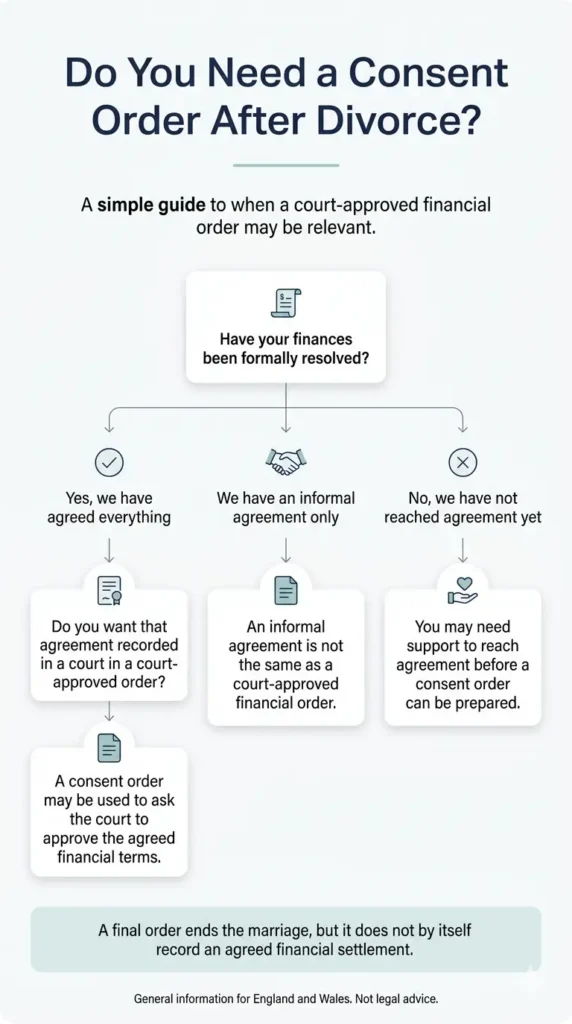
    Infographic decision tree titled "Do You Need a Consent Order After Divorce?" illustrating the process for financial settlements in England and Wales.
    A simple guide to understanding when a court-approved financial order (Consent Order) may be relevant after your divorce is finalised in England and Wales.

    A consent order is a proposed financial order that reflects an agreement already reached between you and your ex-partner. Instead of asking the court to decide a financial dispute after a hearing, you are asking the court to approve the terms you have both agreed. The court says that when you ask for approval, you and your ex-partner must draft a consent order, sign it, complete a statement of information form, and send the required documents and fee to the court.

    This matters because reaching an agreement between yourselves does not automatically make it enforceable. A consent order is the step that asks the court to turn an agreed financial arrangement into a formal court order. Divorce finance guidance separates informal agreement from a court-approved financial order, which is why many people choose to formalise matters even when relations are relatively cooperative.

    What is Form D81?

    Form D81 is the statement of information used to support an application for a consent order in relation to a financial remedy. HMCTS says the purpose of the form is to help the court decide whether the financial and property arrangements you have made are fair.

    In practice, Form D81 gives the judge a snapshot of both parties’ financial position and the terms of the agreement. That is why it is so important to complete it carefully and honestly. The form itself refers to matters such as dates of birth, relevant children, income, assets, liabilities, and whether a decree absolute or final order has been made.

    Do I need a consent order after divorce?

    Not everybody applies for a consent order, but it is often an important step where money, property, pensions, or ongoing financial claims need to be settled clearly. The court’s guidance on money and property after divorce says that if you want a legally binding arrangement for dividing finances, you need to apply to the court. That is the practical reason people often ask for a consent order even where they are already in agreement.

    This is especially relevant where there are assets to divide, pension issues to deal with, or a wish to bring financial claims to an end as far as possible. The blog should be careful here: a consent order is not “mandatory” in every case, but it is often the route people use when they want legal certainty around an agreed settlement. That is a safer and more accurate way to explain it.

    When should you apply for a consent order?

    The court says it is usually simpler to ask the court to approve a consent order after you have your conditional order (or decree nisi), because the court cannot approve a consent order before that stage. The same guidance also says you should apply before your final order (or decree absolute), because leaving it until after final order can have financial consequences, particularly for pensions.

    That timing point is one of the most important practical issues in this whole area. A lot of people assume that once the divorce is finished, they can sort out finances later with no downside. HMCT’s guidance makes clear that this can be risky, which is why consent-order timing should always be considered alongside the divorce timetable.

    Should you get a consent order before the final order?

    In many cases, yes. The court expressly says that if you want a legally binding arrangement for dividing money and property, you should apply for it before applying for the final order or decree absolute. It also says the consent order itself will only take effect after the final order or decree absolute is made.

    That means two things can be true at once. First, the court normally wants the application for approval to come before final order. Second, the consent order does not take effect until final order is made. For readers, that is the key timing sequence to understand.

    What happens if you divorce without a consent order?

    If you divorce without putting a legally binding financial order in place, you may leave financial matters unresolved. HMCTS guidance does not say that every divorced person must get a consent order, but it does say that if you want a legally binding arrangement for dividing money and property, you need to apply to the court. That is why many people seek advice about a consent order even when they believe they have already agreed everything informally.

    This does not mean every case will require the same solution. However, it does mean a blog on this topic should explain that divorce itself and financial finality are not always the same thing. The divorce ends the marriage; the financial order deals with agreed financial arrangements.

    Can mediation help before a consent order?

    Often, yes. Mediation can help separating couples discuss finances and reach proposals without asking the court to decide the outcome for them. If agreement is reached, the next step may then be to ask the court to approve that agreement through a consent order. That creates a natural bridge between mediation and the formal court approval process. Part 9 of the Family Procedure Rules governs financial remedy applications, while the court explains the separate practical steps for asking the court to approve a consent order.

    At the same time, mediation and a consent order are not the same thing. Mediation may help people reach terms, but the consent order is the stage where the court is asked to approve the agreed financial arrangement. Form D81 supports that approval process by giving the court information about the parties’ financial circumstances.

    How does this differ from Form A and Form E?

    This is a different part of the divorce-finance journey. Form A and Form E are more closely associated with starting and managing a financial remedy application where finances are disputed or require formal disclosure. By contrast, consent orders and Form D81 sit more naturally in the agreed-settlement pathway. The courts separates Form A from the D81 consent-order material, and Part 9 of the Family Procedure Rules applies broadly to financial remedy applications.

    A practical next step

    If you have reached agreement about money or property after divorce, the next question is usually whether that agreement now needs to be turned into a legally binding order. In England and Wales, that is where the consent-order process and Form D81 commonly come in. GOV.UK’s guidance makes clear that timing matters, especially in relation to conditional order and final order.

    For many people, the safest next step is to understand whether agreement has really been reached, whether mediation may still help refine the details, and whether the paperwork for a consent order is ready to go to court. That is often the point at which people ask about Form D81, legal drafting, and when to apply before final order.

    Book a consultation regarding your divorce mediation.

    0330 133 4858 Mon – Friday 9.00am – 5.00pm

    Further Information:

  • Form A and Form E: Applying for a Financial Order in England and Wales

    If you are sorting out finances after divorce or separation, two forms often cause confusion: Form A and Form E. They are linked, but they do different jobs. In England and Wales, Form A is used to start a request for a financial order in divorce or civil partnership proceedings, while Form E is the financial statement used for disclosure in those proceedings. GOV.UK describes Form A as the form to start a request for a financial order, and the official Form E notes say it should be completed where an application for a financial order has been made in England and Wales.

    For many people, the hardest part is not the paperwork itself. It is understanding where these forms fit into the wider financial remedy process, when mediation may come first, and what happens if agreement is not possible. This guide explains the role of Form A, Form E, and the court-led process for resolving money and property issues in England and Wales.

    What is Form A?

    Form A is the form used to begin an application for a financial order. GOV.UK says it is used to start a request for a financial order in proceedings for divorce or ending a civil partnership. The current Form A also states that, before making an application for a financial order, you must first attend a Mediation Information and Assessment Meeting (MIAM) unless an exemption applies.

    In practical terms, Form A is often the point where a financial dispute becomes a formal court process. People usually consider this route when:

    • they cannot reach agreement about money or property
    • disclosure is incomplete or disputed
    • there are concerns about delay, non-cooperation, or hidden assets
    • mediation is unsuitable or has not resolved the issues

    A financial order can cover matters such as property, lump sums, maintenance, and pensions, depending on the case. Part 9 of the Family Procedure Rules governs applications for a financial remedy in England and Wales.

    What is Form E?

    Form E is the financial statement used in financial order cases. The official form says it should only be completed in applications for a financial order in divorce, dissolution, annulment, or separation proceedings in England and Wales, or in certain overseas-relief cases. The accompanying notes also explain that you should only complete Form E if you or your spouse or civil partner has made an application for a financial order.

    Form E is about financial disclosure. It is designed to give the court, and the other person, a detailed picture of your financial circumstances. That commonly includes:

    • income
    • bank accounts and savings
    • property
    • debts and liabilities
    • pensions
    • investments
    • business interests
    • future financial needs

    The official Form E notes state that each person must give “full, frank and clear disclosure” of all relevant financial circumstances. They also warn that if full and accurate disclosure is not given, a court order may later be set aside.

    What is the difference between Form A and Form E?

    The simplest way to understand the difference is this:

    • Form A starts the court application
    • Form E provides the financial disclosure within that process

    So, if you are asking the court to deal with finances, Form A is the form that opens the case. Form E is then used to set out the financial information the court needs to understand the dispute. That structure is reflected in GOV.UK’s Form A guidance and in the official Form E notes.

    Do you need a MIAM before Form A?

    Usually, yes. The current Form A says that before making an application for a financial order you must first attend a MIAM, where an authorised family mediator will consider whether mediation or another form of non-court dispute resolution may be more appropriate, unless an exemption applies.

    That does not mean mediation is right for every case. Sometimes mediation can help people discuss finances constructively. In other cases, especially where there is serious non-disclosure, coercive control, safeguarding concerns, urgency, or another valid exemption, a court route may be more appropriate. The key point is that the MIAM requirement and the possibility of exemptions sit at the start of the process.

    When are Form A and Form E usually used?

    Form A and Form E are usually relevant when finances cannot be resolved informally or through mediation alone. That may include cases involving:

    • disagreement about the family home
    • disputes about savings or debts
    • pension issues
    • maintenance claims
    • concerns about business interests
    • suspected hidden assets
    • failure to provide proper disclosure

    Part 9 of the Family Procedure Rules applies to applications for a financial remedy, and Practice Direction 9A supplements that procedure.

    What happens after Form A is filed?

    Once a financial remedy application is underway, the court process usually moves into structured disclosure and appointments under Part 9. While the exact route can vary by case type, the overall purpose is to move the matter through disclosure, negotiation, and, if possible, settlement. Part 9 also defines the Financial Dispute Resolution appointment (FDR), which is a settlement-focused stage within the process.

    This is one reason why Form E matters so much. Without proper financial disclosure, meaningful negotiation is difficult. Where disclosure is incomplete or inconsistent, the process can become slower, more expensive, and more stressful.

    What if your ex will not provide proper disclosure?

    This is one of the most common concerns in financial cases. A person may engage in discussions at first but still avoid full disclosure. For example, they may:

    • delay producing bank statements
    • minimise income
    • omit investments
    • fail to explain transfers
    • leave out cryptocurrency or overseas assets

    The official Form E notes make clear that full and accurate disclosure is required, and that a failure to provide it can have serious consequences for any resulting order.

    Mediation can sometimes help identify gaps in information, but a mediator does not act as a judge or investigator. If one person will not disclose properly, a formal court process may be needed so the case can proceed within the financial remedy framework.

    Can mediation still help before or alongside this process?

    Sometimes, yes. The Form A guidance itself highlights the role of the MIAM and non-court dispute resolution before an application is made. For some couples, mediation may help narrow issues, improve communication, and support discussions about finances.

    However, mediation has limits. It usually works best where both people are willing to engage honestly and provide a reliable picture of their finances. If there are serious concerns about hidden assets, intimidation, or refusal to disclose, mediation may not be enough on its own.

    What does the court mean by “financial remedy”?

    Under Part 9 of the Family Procedure Rules, the process is described as an application for a financial remedy. That term covers a range of financial orders the court can make in family proceedings. The official rules govern how those applications proceed, including disclosure and court appointments.

    For readers, the important point is that Form A and Form E are not random paperwork. They sit inside a formal system designed to deal with finances when agreement has not yet been reached.

    Is this the same as a consent order?

    Not exactly. A consent order usually relates to an agreement that has already been reached and is then sent to the court for approval. By contrast, Form A and Form E sit more naturally in the court-application and disclosure side of the process, where finances are disputed, unresolved, or still being worked through. GOV.UK separates Form A guidance from the consent-order materials, which is one reason these topics are better treated as different content clusters.

    A practical next step

    If you are trying to understand Form A and Form E in England and Wales, the first question is usually whether finances can still be resolved through discussion or mediation, or whether a formal financial remedy application is becoming necessary. Where agreement is not possible, or where disclosure is a problem, legal advice may be important.

    A MIAM may still be the first step unless an exemption applies. From there, the question is whether mediation is realistic, or whether the matter is likely to move into the court-led process involving Form A, Form E, and wider financial disclosure.

    This content is for general information only and is not legal advice.

    Further Information:

  • Hidden Assets in Divorce and Separation in England and Wales

    Divorce and separation can already feel uncertain. However, when one person suspects the other is hiding money, property, or investments, the situation often becomes even more stressful. In England and Wales, financial arrangements after divorce depend heavily on proper financial disclosure. The official Form E states that each person has a duty to give the court “full, frank and clear disclosure” of their financial and other relevant circumstances, and warns that failure to do so may result in an order being set aside.

    For some people, the concern is a bank account that was never mentioned. For others, it may be cryptocurrency, money moved overseas, or funds held in an offshore account. In practice, the issue is rarely just about the asset itself. Instead, the real problem is whether both people are being open enough for mediation or financial negotiations to work fairly.

    What are hidden assets?

    Hidden assets are assets, income, or resources that one person does not properly disclose during divorce, separation, or financial remedy discussions. They may include:

    • bank accounts not mentioned in disclosure
    • savings transferred elsewhere
    • undeclared bonuses, commissions, or business income
    • investments and shareholdings
    • property held through a company or another person
    • money held abroad
    • offshore accounts
    • cryptocurrency and other digital assets

    Not every unfamiliar transaction proves wrongdoing. Even so, if a significant asset or source of income is left out of disclosure, that can affect the fairness of any proposed settlement.

    Why disclosure matters in England and Wales

    A fair financial outcome depends on both people understanding the true financial picture. Under the Family Procedure Rules, financial remedy cases in England and Wales are governed by Part 9, and the court process includes formal financial disclosure through Form E and related evidence.

    That matters in mediation too. Mediation can help couples discuss finances in a more structured and constructive way. However, mediation usually works best where both people are willing to engage honestly. If one person appears to be concealing assets, withholding documents, or giving inconsistent information, the process may become limited or unsuitable.

    Common signs a partner may be hiding assets

    Suspicion does not always mean concealment. Nevertheless, some signs can justify closer scrutiny. For example:

    • incomplete or delayed disclosure
    • vague explanations about finances
    • sudden transfers between accounts
    • unusual cash withdrawals
    • unexplained reductions in salary or business income
    • missing bank statements or tax documents
    • references to trading platforms, wallets, or overseas accounts
    • assets appearing in the name of a friend, family member, or company

    These signs do not prove that assets are being hidden. Even so, they may indicate that further clarification, legal advice, or formal disclosure is needed.

    Can cryptocurrency be hidden in divorce?

    Yes, cryptocurrency can be relevant in divorce and separation. If digital assets exist, they should form part of the wider financial disclosure picture, even though they may be harder to identify and value than a traditional bank account.

    Cryptoassets may include:

    • Bitcoin
    • Ethereum
    • stablecoins
    • token-based investments
    • assets stored on exchanges
    • assets stored in software or hardware wallets

    In some cases, the difficulty is not whether the crypto exists, but where it is held, whether it has been moved, and how it should be valued. Because crypto can be transferred quickly and may be spread across multiple platforms or wallets, it can create additional complexity. Even so, it is still part of a person’s financial circumstances and should not be omitted simply because it is digital.

    Offshore accounts and overseas assets

    Offshore accounts are another area of concern. An offshore account is not automatically improper. However, if it exists and is relevant to a person’s financial circumstances, it should be disclosed.

    The same can apply to:

    • overseas bank accounts
    • foreign property
    • international investments
    • offshore companies
    • trusts or nominee arrangements

    Where money has been moved abroad, or assets are held through more complicated structures, it may be harder to understand the full position. Even so, the key issue remains the same: honest disclosure.

    Can mediation help if you suspect hidden assets?

    Sometimes, yes. Mediation can still be useful where both people are broadly willing to engage and the concern is about clarification rather than deliberate concealment. A mediator can help structure discussion, identify gaps in information, and encourage both sides to work from the same financial picture.

    However, mediation has limits. A mediator is neutral and does not act as a judge, investigator, or forensic accountant. While a mediator can facilitate the exchange of information, they do not have the power to investigate, cross-examine, or verify documents in the way a court can. Because of that, mediation may not be enough where serious non-disclosure is suspected.

    If one person refuses to provide proper information, gives inconsistent answers, or appears to be concealing assets, mediation may stall or become unsuitable. In more complex cases, including those involving business interests, cryptocurrency, offshore accounts, or disputed disclosure, some people also seek support from a solicitor or forensic accountant alongside the mediation process.

    What happens if assets are not disclosed?

    The consequences can be serious. Form E warns that failure to give full and accurate disclosure may result in a court order being set aside. It also notes that deliberate failure may amount to fraud.

    In practical terms, non-disclosure can lead to:

    • delay in settlement
    • more requests for documents and information
    • greater legal cost
    • loss of trust in negotiations
    • court involvement where agreement cannot be reached
    • future challenges to an order if important assets were concealed

    So, even where a case begins in mediation, unresolved concerns about hidden assets can push the matter toward a more formal process.

    What if your ex refuses to disclose properly?

    This is one of the most common concerns in financial disputes. A person may attend mediation or financial discussions, but still avoid meaningful disclosure. For example, they may:

    • refuse to provide statements
    • minimise the value of assets
    • deny owning cryptocurrency
    • fail to explain overseas transfers
    • provide incomplete information about business interests

    Where that happens, mediation may no longer be productive. A mediator can identify that disclosure is incomplete, but cannot force a person to be truthful in the same way a court process can. In England and Wales, the court’s financial remedy framework provides for structured disclosure and further steps where more information is needed.

    Does a MIAM still matter in these cases?

    Sometimes it does. Under Part 3 of the Family Procedure Rules and Practice Direction 3A, a MIAM is usually required before certain family court applications unless an exemption applies, and the practice direction says prospective respondents are expected to attend as well.

    Even so, attending a MIAM does not mean mediation must continue. If the issue is serious concealment, power imbalance, or unsuitability, mediation may not be the right forum. In that situation, a MIAM can still help clarify the next step.

    Can funding or vouchers help?

    Possibly, but only in some cases. GOV.UK says the Family Mediation Voucher Scheme can provide a one-off contribution of up to £500 towards eligible mediation cases. It does not cover the cost of the MIAM itself, and not all cases qualify. GOV.UK also states that if one or both people are eligible for legal aid, funding may cover the MIAM and mediation sessions through providers who offer legal aid work.

    That said, a voucher does not solve a disclosure problem by itself. The more important question is whether there is enough openness for mediation to be workable.

    What should you do if you think your partner is hiding assets?

    The safest approach is usually to stay organised and factual. It may help to:

    • keep copies of financial documents you already lawfully have
    • note accounts, transfers, or transactions you do not understand
    • raise concerns clearly and calmly
    • ask whether mediation is suitable
    • seek independent legal advice where concealment appears serious

    If court proceedings become necessary, the financial remedy process can provide a more formal framework for disclosure and follow-up questions. GOV.UK also explains that if couples cannot agree on money or property, they may ask the court to make a financial order.

    A practical next step

    If you are worried that your ex-partner is hiding assets, cryptocurrency, or offshore money, the next step is often to understand whether mediation is still realistic or whether legal advice is needed straight away. In some cases, mediation can still help clarify the issues. In others, the lack of openness may mean a more formal route is appropriate.

    This content is for general information only and is not legal advice.

    Further infromation:

  • How the Court Process Can Put Your Finances at Risk in Divorce

    Divorce is not only a legal process. It is also a period of financial exposure. Once a dispute enters the court system, the timing, cost, and structure of decision-making are shaped by an institution operating under significant pressure.

    This risk arises from the structure of litigation itself, rather than from the financial complexity of the case.


    What Is Litigation Risk in Divorce?

    Litigation risk arises when control over pace, cost, and direction moves from the individuals involved to the court process. Once proceedings begin, opportunities to pause, regroup, or adjust approach become limited.

    This commonly results in:

    • Fixed delays
      Hearings are scheduled according to court availability rather than financial need.
    • Loss of procedural control
      Progress is driven by administrative timetables rather than financial logic.
    • Increased formalisation
      Sensitive financial information is recorded and revisited repeatedly.

    How the Court Process Can Deplete Assets

    Legal costs are often driven by how long a case runs rather than how complex the finances are. When disputes follow a full court timetable, costs can accumulate quickly.

    Common contributors include repeated disclosure requests, judicial inconsistency across hearings, and escalating correspondence driven by the adversarial structure of litigation.


    The Risk of a Non-Negotiated Outcome

    Leaving asset division entirely to a court introduces unpredictability. Orders may be inflexible, and assets such as homes or businesses may be subject to court-directed sale, even where alternative arrangements could have preserved value.


    Summary of the 2026 Risk Landscape

    For many individuals in 2026, the central financial risk is no longer about winning a legal argument. It is about recognising when delay, cost, and uncertainty begin to erode the value of the eventual settlement.

  • The Risk of Agreeing to a Divorce Settlement Without Full Financial Clarity

    In financial separation, agreement is often treated as a binary outcome: either both parties consent, or they do not. In practice, consent exists on a spectrum. Illusory consent arises when agreement is recorded without clear evidence that the financial implications have been fully understood or tested.

    This risk concerns how agreement is reached and recorded, not whether the outcome appears fair or cooperative.


    What Is Illusory Consent?

    Illusory consent occurs when a settlement reflects acceptance in form but not in substance. One or both parties may agree to figures, summaries, or proposals without fully interrogating how those terms operate over time.

    Silence, lack of objection, or procedural compliance are treated as confirmation of understanding, even where key financial assumptions remain unexamined.

    This risk is not about how quickly figures are reviewed, but about how well they are understood, even where time has been taken.


    How Illusory Consent Develops

    Illusory consent typically forms through routine procedural pathways rather than overt disagreement. Common mechanisms include:

    • Unchallenged summaries
      Financial positions are accepted at a high level without examining underlying detail.
    • Assumption inheritance
      Early figures are carried forward without being revisited as understanding evolves.
    • Asymmetric engagement
      One party actively interrogates the settlement while the other participates passively.
    • Process momentum
      As agreement appears close, unresolved questions remain unresolved by default.

    None of these require pressure or misrepresentation. They arise from how agreement is recorded rather than how it is understood.


    Why Silence Is Not Evidence of Understanding

    A lack of challenge may indicate clarity, but it may equally indicate uncertainty, disengagement, or reliance on incomplete information. Where silence substitutes for scrutiny, risks remain embedded until assets are accessed or relied upon for income.


    Summary of the 2026 Risk Landscape

    In 2026, the stability of a divorce settlement depends not only on what is agreed, but on how that agreement was formed. Where consent quality is low, financial imbalance often becomes visible only after the opportunity to correct it has passed.


    Other articles to consider reading:

  • Why Amicable Divorce Settlements Can Still Carry Financial Risk

    A cooperative or low-conflict divorce process is often assumed to be safer than a contested one. Agreements reached calmly can feel stable, proportionate, and balanced at the point of signing. However, reduced conflict does not guarantee that financial decisions have been fully examined.

    In later-life divorce in particular, a smooth process can conceal weaknesses that only become visible years later.

    This article addresses harmony-driven financial risk, not procedural delay or court involvement.


    What Is the Core Financial Risk in Amicable Settlements?

    The central risk is that reduced challenge leads to reduced scrutiny.

    This risk is not driven by speed or procedural shortcuts, but by how cooperation can limit the testing of assumptions. Where maintaining harmony becomes the dominant objective, financial interrogation may diminish, even in complex cases.

    In later-life separation, this risk is magnified by two structural factors:

    • Asset–income mismatch
      Settlements are expected to support long-term living costs without the buffer of future employment income.
    • Limited recovery window
      Errors relating to pensions or tax cannot easily be absorbed or corrected later.

    In cases involving pensions, professional standards such as Pensions Advisory Group (PAG) guidance recognise that headline values alone do not reliably indicate long-term income outcomes.


    How Cooperation Can Reduce Financial Challenge

    A calm process is often interpreted as progress. In practice, it can reflect disengagement from financial questioning rather than informed agreement.

    Common patterns include:

    • Superficial parity
      Headline splits that appear equal but ignore differences in income yield, tax treatment, or liquidity.
    • Bypassed scrutiny
      Detailed examination of pensions, tax exposure, or long-term affordability is avoided to preserve cooperation.
    • Suppressed questioning
      Revisiting assumptions can feel disruptive, so early figures and valuations go untested.

    These patterns do not arise from bad faith. They emerge from prioritising short-term harmony over sustained financial examination.


    Why Problems Often Appear Later

    Settlements reached with limited challenge rarely fail immediately. Weaknesses tend to emerge when assets are accessed, income is required, or costs increase over time.

    By the time these issues surface, the opportunity to adjust the agreement is usually extremely limited.


    Summary of the 2026 Risk Landscape

    In later-life divorce, calm is not a reliable indicator of safety. Cooperation can reduce emotional strain, but it does not remove financial risk. Where scrutiny is reduced in the name of harmony, instability is often embedded into the settlement itself.

  • The Financial Risk of Fast Divorce Settlements

    A divorce settlement reached quickly can appear efficient and decisive. However, when a fast divorce settlement becomes the primary objective, financial complexity is often deferred rather than resolved. These issues relating to pensions, tax exposure, and long-term cash flow are frequently simplified, even though their consequences unfold over decades.

    What appears straightforward at the point of settlement can therefore create instability years later, when legal and procedural options to revisit the arrangement are limited.

    This article addresses speed-driven financial risk, not the quality of cooperation between parties.


    What Is the Primary Risk of a Fast Divorce Settlement?

    The primary risk is that financial scrutiny is compressed to meet procedural pressures. Specifically, when pensions and tax implications are not examined in detail, their impact is postponed rather than eliminated. This means that the risk arises from the speed of the settlement, not from the level of cooperation between parties.

    In practice, speed-led settlements commonly involve:

    • Reliance on headline figures
      Pension and asset values are treated as fixed numbers, despite the fact that pensions, in particular, require specialist analysis to understand how value translates into future income.
    • Procedural shortcuts
      Detailed financial modelling takes time. When this work is reduced or bypassed to achieve a rapid conclusion, the resulting settlement may lack long-term resilience.
    • Deferred technical issues
      Tax exposure, access sequencing, and liquidity constraints are acknowledged in principle but not examined in detail, leaving risk embedded in the structure of the agreement.

    Why Surface-Level Fairness Can Be Misleading

    An apparently even division of assets can feel fair at the point of agreement. Nevertheless, assets with the same headline value can perform very differently over time. For instance, two assets of equal value may produce different long-term income. Furthermore, some assets lose value when sold due to deferred tax liabilities.

    Common hidden risks include:

    • Unequal income generation
      Two assets of equal value may produce very different levels of long-term income.
    • Deferred tax liabilities
      Some assets lose a significant proportion of their value when sold, transferred, or accessed.
    • Liquidity imbalance
      Property-heavy settlements can leave an individual asset-rich but cash-poor, limiting flexibility to meet everyday living costs.

    How Pensions and Tax Are Commonly Oversimplified

    Fast settlements often rely on assumptions that pensions and tax can be “balanced later”. In practice, once a final order is made, opportunities to restructure assets in a tax-efficient way are often reduced or lost.

    Pensions, in particular, are frequently treated as capital equivalents, despite the fact that their real value lies in the income they generate over time and the conditions under which that income can be accessed.


    Summary of the 2026 Risk Landscape

    In 2026, simplicity in divorce settlement often refers to speed rather than financial security. Where complexity is compressed to reach agreement quickly, it commonly re-emerges later as instability.

    Distinguishing between a settlement that is fast and one that is financially robust is a critical step before any agreement is finalised.


    Other articles to consider reading: